Best Time to Leave Fredericksburg VA to Avoid I-95 Traffic to DC
If you're driving north, the timing question comes down to beating the commute: rolling out around 5 am can put you in Northern Virginia near 6 am, while 7 to 9 am is when I-95 thr...

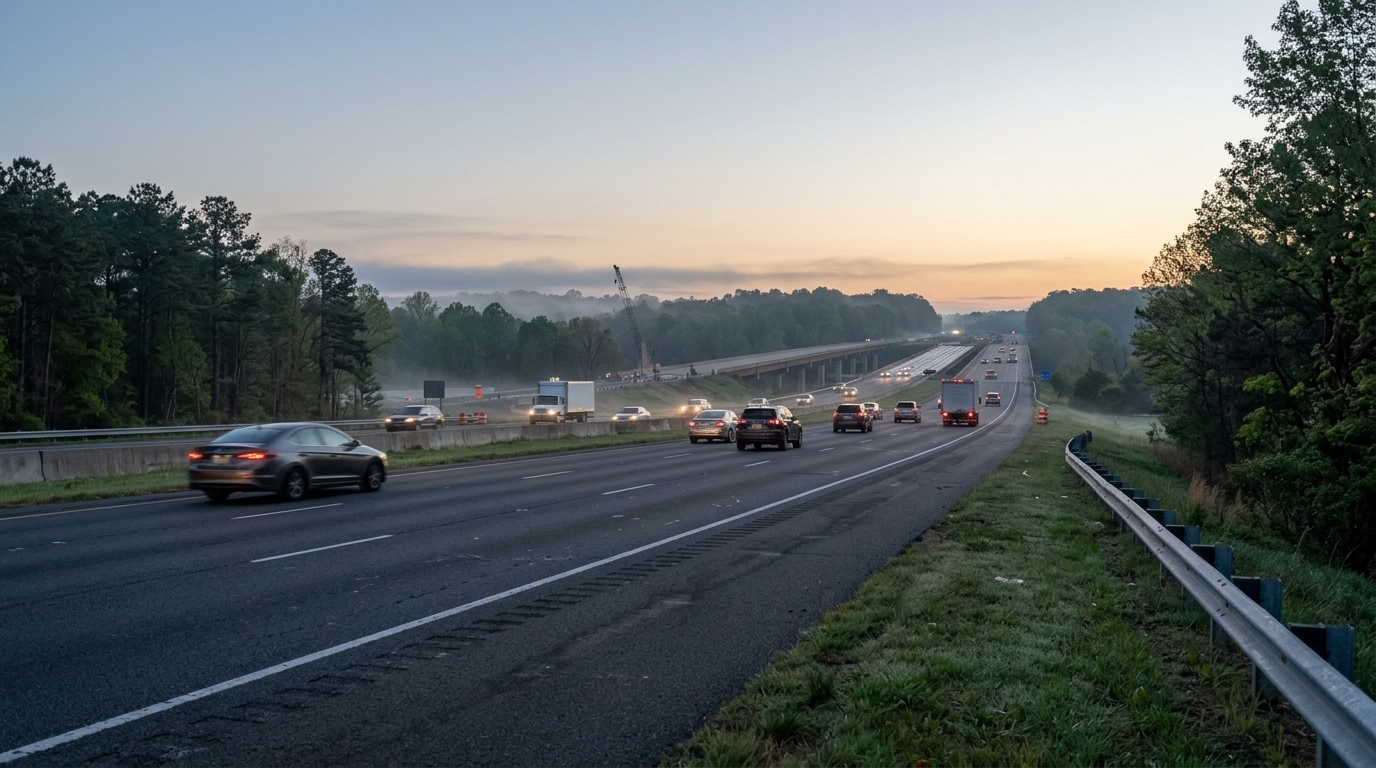
Fredericksburg · Community Photo
If you're driving north, the timing question comes down to beating the commute: rolling out around 5 am can put you in Northern Virginia near 6 am, while 7 to 9 am is when I-95 through Fredericksburg slows to a crawl. Treat every window here as planning guidance, not a promised travel time — check live road conditions before you pull out, and remember that mid-day and late-night runs usually move far better than the morning peak.
If your arrival time in DC is fixed, the practical move is to leave Fredericksburg before the weekday northbound commute settles in. Think of the early-morning window ahead of 7 am as general guidance, not a guarantee: it gives you a buffer before the heaviest push toward Northern Virginia, but conditions can still change. When your morning is flexible, a later departure after the 9 am rush often feels calmer, though you should check the full route before you commit.
Traffic can build well north of the Rappahannock even when your start in Fredericksburg looks clear, and one slow stretch near the Route 3 interchange can ripple into the rest of the drive. That is why the best time to leave Fredericksburg VA to avoid I-95 traffic to DC is less a single clock time than a window you confirm on the day.
Use live route estimates for your actual destination, watch Interstate 95 conditions through Fredericksburg and beyond, and let the whole Fredericksburg VA to Washington DC drive shape your choice. For a fixed appointment, leave earlier than you think you need; for a flexible morning, wait until the rush eases and verify the road again. Either way, treat any suggested departure as planning advice, not a promised travel time.
Choose your departure window: weekdays, weekends, holidays
Trip situation | Departure strategy | Why it helps | What to check |
|---|---|---|---|
Weekday early appointment northbound to Northern Virginia or Washington, D.C. | Leave before 7:00 AM, or wait until the morning push eases after 9:00 AM. If the appointment cannot move, staging north of the worst backups before 7:00 AM is the safer planning choice. | The heaviest northbound build-up runs roughly 7:00 AM to 9:30 AM, when commuter volume compounds through the Exit 130 to Exit 133 stretch. Interstate 95 carries over 150,000 vehicles per day through Fredericksburg, a recognized regional bottleneck. | Use 511 Virginia for overnight construction and crash reports, and confirm the Express Lanes direction before merging. |
Flexible weekday visit | Aim for the middle of the day, after the morning commute settles and before the afternoon southbound build-up begins. A late-morning start after 9:00 AM often flows more smoothly than a pre-dawn push. | Volume drops between the morning commercial rush and the afternoon rush, which begins as early as 3:00 PM and runs through 6:30 PM on southbound lanes. | Check live mapping for incidents near the Rappahannock River bridges, and watch for changing Express Lanes direction. |
Friday trip | Start in the late morning, before the standard afternoon rush, or push the drive to late evening. Friday afternoons bottleneck early because commuters mix with weekend getaway traffic. | The compounding effect begins before the usual afternoon peak, so an early start or a later departure avoids the worst of the merge. | Review VDOT weekend maintenance schedules and real-time congestion alerts along the corridor. |
Ordinary weekend | Travel mid-morning or early afternoon. Expect steadier flow than a weekday, though recreational traffic can still create friction. | Roughly 75% of heavy commercial and daily commuter traffic is absent, so baseline volume is lighter than weekdays. Southbound midday friction and northbound event backups can still appear. | Check local event traffic and weekend lane closures through 511 and Waze. |
Holiday weekend | Leave in the pre-dawn hours on travel days, or consider traveling on the holiday itself. The days preceding major holidays, including Tuesday evenings, are peak surge windows. | Major holiday periods cause extreme gridlock in both directions through Fredericksburg. Early morning departures or holiday-day travel can catch a temporary dip in baseline volume. | Monitor AAA holiday forecasts, VDOT Fredericksburg district advisories, and consider US-1 or US-301 when heading off-corridor. |
Why a Clear Start Can Still Turn Into a Slow Drive
Your on-ramp can be wide open and the drive can still grind to a halt. The northbound run from Fredericksburg to Washington is one corridor with several distinct personalities, and what you can see from the windshield in the first few minutes tells you very little about what you will meet an hour later. Interstate 95 carries over 150,000 vehicles per day in Fredericksburg alone, and that volume does not evaporate once you clear the city line.
Every Thursday — local news, events, deals, and new listings. Free forever.
Check the roads and express lanes before you leave
Before you leave the driveway
A five-step departure check for the trip toward Washington, D.C.
-
1
Set the real destination and arrival time
Use the exact address and the time you need to be there—not a loose target.
-
2
Scan the whole route
Open 511 Virginia for live incidents, cameras and planned work. Look north past the Rappahannock River bridge area near mile marker 133, where construction and lane closures often appear.
-
3
Compare current options
Check your navigation app against the live 511 Virginia view before you commit. If one misses a crash or closure, choose the fuller picture.
-
4
Confirm express-lane direction and access
Check the reversible schedule on ExpressLanes.com or the app.
NMorning — north toward D.C.SLater — south toward Fredericksburg and StaffordYou need an E-ZPass or E-ZPass Flex; cash is not accepted.
E-ZPass or E-ZPass Flex No cash HOV-3+ toll-free with Flex set to HOV ON Motorcycles toll-free, no transponder -
5
Recheck before you go
Refresh 511 Virginia and the Express Lanes schedule one last time, then leave ready to adjust.
Before you commit to a departure window, check the corridor the way you would check the weather: official sources first, a second opinion for the local stretch, and one more look right before you pull out. Virginia's 511 system, run by the Virginia Department of Transportation, is the place to start. It carries real-time traffic, live road conditions, active highway cameras, incidents, and planned lane closures or travel advisories. You can reach it at 511virginia.org or through the official mobile app, and it covers the whole route north from Fredericksburg toward Washington, D.C., not just the first few miles.
For a supplemental read on the Fredericksburg stretch, live I-95 reports for the Fredericksburg stretch can help you see what is happening near exits 130 and the Route 3 interchange before you lock in a time. Treat that as a second set of eyes rather than an official VDOT feed; the state 511 page remains the authority for closures and incidents.
Then separate the two kinds of pavement in your head. The general lanes on Interstate 95 are open to everyone and are where the daily volume piles up. The 95 Express Lanes and 395 Express Lanes are a separate, tolled network that runs alongside, and they are not a standing invitation at every hour. Access requires an E-ZPass or E-ZPass Flex transponder, and cash is not accepted. Vehicles with three or more occupants can ride toll-free when an E-ZPass Flex is set to "HOV ON," and motorcycles ride toll-free without a transponder. Tolls are set by overhead dynamic pricing signs that update continuously with real-time conditions, so a price you remember from last week is not a price you can count on today. The operator's app and website also show live camera feeds and entry and exit locations along the 95 and 395 Express Lanes, which matters if you are deciding whether the tolled option is even usable for your trip.
The bigger reason northbound express-lane availability is not constant is direction. The 95 Express Lanes extend over 40 miles and use reversible operations that change based on peak travel flows, running northbound toward D.C. in the mornings and southbound toward Fredericksburg and Stafford in the afternoons and evenings. The 395 Express Lanes continue northward into D.C. near the 14th Street Bridge, and the same transponder rules apply across that network. If you are leaving at an odd hour, or on a weekend, do not assume the lanes are pointing your way. Check the operator's schedule tool before you go, and read how the express lanes switch direction so you understand the reversal rather than guessing at it.
Local bottlenecks deserve their own check. The Rappahannock River bridge area, around mile marker 133 in the Fredericksburg region, is where construction and lane closures frequently occur, so a planned closure there can undo an otherwise good departure choice. Scan the 511 travel advisories for that stretch, and look at the cameras rather than relying on a memory of how the bridge usually moves.
Finally, reassess right before you leave. Conditions on this corridor change with incidents and work zones, and patterns are guidance, not a promise. A quick refresh of 511 Virginia and the express-lane schedule turns general timing advice into a same-day decision you can actually trust.
When the train makes more sense than the drive
If your day in Washington has a fixed start — a meeting, an appointment, a ticket with your name on it — the calculation changes. A driving window that looks comfortable on an average morning can collapse around one incident near the Route 3 interchange or a slowdown farther north, and there is no guaranteed traffic-free departure time on the corridor. That is where rail earns its place in the plan, especially for readers whose schedule does not fit a quieter driving window.
Fredericksburg Station sits at the historic 1910 brick depot at 715 Princess Anne Street, one block from the Rappahannock River waterfront. A $14.4 million renovation completed in 2024 rebuilt platforms and stairways, upgraded ADA access, added lighting and signage, and improved parking connections, so the station itself is less of a wild card than it once was. Two operators serve it, and they behave differently.
The Virginia Railway Express Fredericksburg Line is the commuter option: it connects Fredericksburg to Northern Virginia and downtown Washington, D.C. at Union Station, with a ride of about 1 hour 30 minutes. Its schedule is built around weekday commuting rather than all-day, all-week service, so the day of your trip matters as much as the hour. Amtrak also stops at Fredericksburg, with routes including the Northeast Regional and the Carolinian/Piedmont, and runs roughly 5 times a day. Fares vary by booking time; regional estimates place them roughly between $29 and $45, with averages around $32. Train travel between Fredericksburg and Washington, D.C. averages about 1 hour 31 minutes to 1 hour 32 minutes, and the fastest options come in around 1 hour 21 minutes. Treat those as planning figures rather than promises, and confirm current service with VRE before you build a day around a specific train.
Before you commit, run through four practical checks. First, which station actually serves your destination? Union Station is not the same as a Metro stop near your meeting, and the last leg may involve a transfer. Second, does the train you want operate on your travel day? Commuter service and Amtrak do not follow identical calendars, and a holiday or a Friday can change the pattern. Third, what is the last practical return? A late meeting can strand a commuter-rail plan that looked fine at 9 am, so look at the evening options before you book the morning. Fourth, how will you get from the station to your final address, and is that onward trip built into your arrival time?
VRE multi-ride passengers can use cross-honor agreements with Amtrak for certain commuter travel, which adds flexibility when schedules align — but confirm the details with the operator rather than assuming. For a schedule overview, this VRE schedules from the Fredericksburg line lookup is a third-party tool, not the operator's official site; treat it as a starting point and verify times, operating days, and return options directly with VRE.
For readers whose arrival deadline does not fit a quieter driving window, the train is often the more honest choice: it trades the variable for the fixed. Check 511 Virginia for live conditions and incidents, review the reversible express-lane direction and dynamic tolls, then compare that picture with the rail option. Whichever mode you choose, build in a cushion and decide which risk you would rather carry.
A fixed arrival time changes the question
If you have to be somewhere in Washington at a set hour — a meeting, an appointment, a reservation — the honest comparison is not "which departure window is quietest" but "which plan can I actually count on today." Check the live picture on 511 Virginia for incidents and lane closures, glance at the Express Lanes app for the reversible direction and current tolls, then put that against a real train itinerary from Fredericksburg Station at 715 Princess Anne Street.
Look at both ends of the trip before you decide. The Virginia Railway Express Fredericksburg Line reaches Union Station in roughly 1 hour 30 minutes, and Amtrak trains average about 1 hour 31 minutes to 1 hour 32 minutes, with the fastest options near 1 hour 21 minutes. Fares for Amtrak are estimated roughly between $29 and $45, averaging around $32 depending on when you book. Then look at the return: a late finish can undo a plan that felt fine in the morning, so compare the last practical train home against the drive back.
Whichever you pick, confirm operating days and current times with VRE, and leave a cushion either way. Rail trades a variable for a fixed — that is the whole point.
Common questions about driving to Washington, DC
Honest answer: no. Between accidents, work zones and the sheer weight of commuter volume on this corridor, nobody can promise you a clean run from Fredericksburg to Washington, D.C. — not us, and not any app. What the patterns do show is a difference in odds. The hours with a reasonable expectation of light traffic are the late-night and pre-dawn ones, such as around 2 am, as long as there is no overnight road work in progress.
Standard peak windows run roughly 7 am to 9 am and 4 pm to 6:30 pm, and around this end of the corridor those pressures often begin earlier and linger later. So treat any departure window as a plan, not a guarantee, and check conditions the morning you go.
It is not, and treating it that way is how a short delay turns into a long one. US Route 1 runs parallel to the interstate and can genuinely help you slip past a localized backup, which is why so many local drivers keep it in their back pocket.
The catch is that everyone else has the same idea. When the interstate locks up, drivers pour off in numbers, and US 1 picks up its own stop-and-go crawling, signal waits and bottlenecks. A useful habit is to glance at side-road conditions before you commit: if the relief route is already filling, you may be trading one jam for another. It is a tool for a specific problem, not a default shortcut.
No — and this is the single most common surprise for newer commuters. Your first few miles can look wide open while the real trouble sits far to the north, in Northern Virginia, where lanes shift or narrow near major bridges and interchanges such as the Occoquan and through regional work zones.
Sudden slowdowns, crashes and rubbernecking frequently appear miles beyond anything you can see from home. That is why a glance out the window at your own street tells you almost nothing. Look up the corridor as a whole before you leave, and expect conditions to change after you have already been driving for a while.
Plenty of trips cannot be moved, and that is fine — you just plan differently. Start with live information rather than habit: 511 Virginia, run by VDOT, plus navigation apps such as Waze or INRIX, will show you what is actually happening instead of what usually happens.
Then look at your options on the road itself. The I-95 Express Lanes can help where they are available, though pricing is dynamic and shifts with demand. Carpooling changes the math: three or more people travelling together with an E-ZPass Flex set to HOV mode can qualify for free travel options. Finally, build slack into your arrival time. On a day when you cannot choose your departure, the cushion is what keeps a delay from becoming a missed appointment.