$120,000 a Year and Still Struggling? The New Cost of Living in Fredericksburg
We make more money than our parents did. So why does buying a home, raising a family, and simply getting ahead feel so much harder? The numbers from Fredericksburg, Stafford, and Spotsylvania tell an interesting story.
By Alex Wilson | Go Fredericksburg | Opinion
Imagine a married couple raising two children in Spotsylvania County.
Both parents work full-time. They have decent jobs, dependable vehicles, and a combined annual income of $120,000.
Twenty years ago, many Americans would have considered that a very comfortable household income.
Even today, it sounds like a good living.
But what if I told you that, according to a respected university's cost-of-living research, $120,000 isn't quite enough to cover the estimated basic expenses of that family in Spotsylvania County?
Not luxury expenses.
Not extravagant vacations, expensive restaurants, or fancy cars.
Just the basic cost of living.
Welcome to the new math of the American middle class.
And if you've lived in the Fredericksburg area for any length of time, you've probably watched it happen right in front of you.
Remember When $100,000 Meant You Had Made It?
There was a time when earning six figures represented a significant financial achievement.
You could reasonably expect to own a home, drive dependable vehicles, raise children, contribute to retirement, and occasionally enjoy the rewards of your hard work.
Today, earning $100,000 can still provide a good living. But whether it's enough depends enormously on where you live, how many people depend on that income, and what you're paying for housing.
Consider the median household incomes reported by the U.S. Census Bureau for our area:
Locality
Median household income
Fredericksburg City
$86,071
Spotsylvania County
$112,738
Stafford County
$137,807
These are 2020–2024 survey estimates expressed in 2024 dollars, not salaries measured in 2026.
Those are respectable numbers.
In fact, both Stafford and Spotsylvania have household incomes well above the national median.
But those figures reveal only what households earn—not what their money can buy.
And that's where the conversation gets interesting.
A Home in Fredericksburg Isn't What It Used to Cost
Let's talk about housing.
According to September 2026 housing reports from the Fredericksburg Area Association of REALTORS, median home sale prices were approximately:
Locality
Median sale price
Fredericksburg City
$499,250
Spotsylvania County
$475,000
Stafford County
$515,000
Now think about that for a moment.
A family earning $100,000 annually is looking at homes priced four to five times its income.
And the purchase price is only the beginning.
Let's take that $475,000 home in Spotsylvania.
With a traditional 20% down payment, the buyer would need $95,000 before paying closing costs.
At Freddie Mac's reported 30-year mortgage rate of 7.24% on October 29, 2026, the monthly principal-and-interest payment would be approximately $2,590.
Add approximately $292 per month in county real estate taxes, assuming the assessed value equals the purchase price and no special district taxes apply.
That's nearly $2,900 every month before homeowners insurance, maintenance, or HOA fees.
And remember, we're talking about someone who already managed to save $95,000.
What about the young family that hasn't?
With just 5% down, the principal-and-interest payment rises to approximately $3,075 per month, before taxes, insurance, and any required mortgage insurance.
The down payment drops, but the monthly burden increases.
This is why so many younger buyers feel trapped.
They're earning good incomes. They're working hard. They're doing many of the things previous generations encouraged them to do.
But the entrance fee to homeownership has become extraordinarily expensive.
What About 50 Years Ago?
This is where we need to be careful with nostalgia.
It's easy to hear someone say they purchased their first home in the 1970s for $40,000 or $50,000 and assume everything was easier.
But mortgage rates were high back then.
The average 30-year mortgage rate in 1976 was approximately 8.87%, and rates eventually exceeded 16% in 1981.
Previous generations certainly faced their own financial challenges.
However, looking at 50 years of local housing data reveals something worth considering.
The Federal Housing Finance Agency tracks changes in home values using county-level house price indexes.
In Spotsylvania County, that index increased from 40.66 in 1976 to 301.78 in 2025.
That's an increase of approximately 642%, meaning the index grew to about 7.4 times its starting level.
Over that same period, overall consumer prices grew approximately 5.7 times.
After adjusting for general inflation, Spotsylvania home prices still increased about 31%.
Stafford tells a similar story.
Between 1977 and 2025, its house price index increased approximately 8.2 times, compared with a 5.3-fold increase in general consumer prices.
That's roughly a 55% increase in inflation-adjusted home values.
These indexes measure changes in home prices, not the price of a particular median home. But the larger point remains.
Local housing hasn't simply become more expensive because everything costs more. It has also grown more expensive relative to the general cost of living.
And that creates a different starting point for families entering the market today.
Let's See Where $120,000 Actually Goes
Now comes the part I think every working parent should see.
The Massachusetts Institute of Technology publishes a Living Wage Calculator estimating what households need to earn to meet basic expenses in communities across the country.
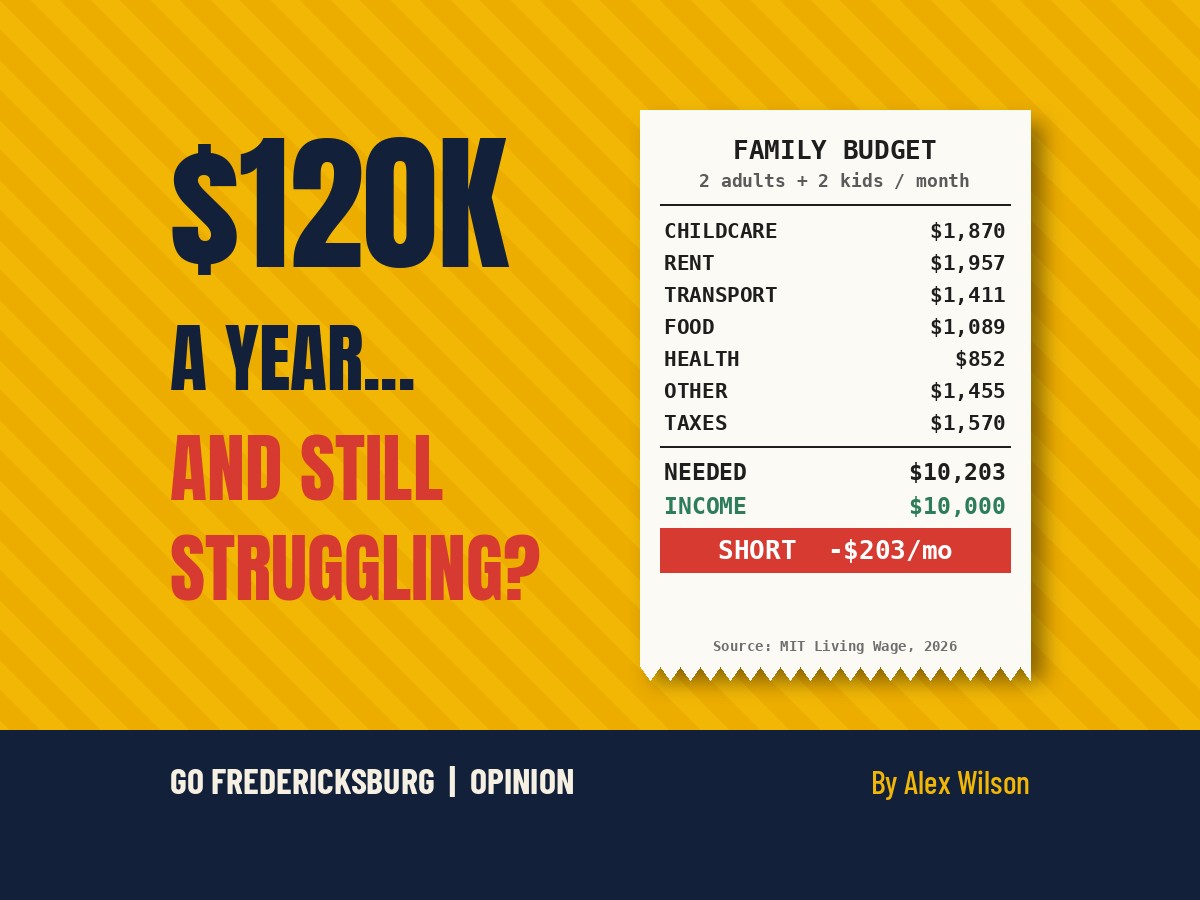
For 2026, MIT estimates that a Spotsylvania household with two working adults and two children needs a combined annual income of approximately $122,438 before taxes.
Here's where the money goes.
Estimated expense
Monthly cost
Housing
$1,957
Childcare
$1,870
Groceries and food
$1,089
Transportation
$1,411
Healthcare
$852
Other basic needs
$1,455
Estimated taxes
$1,570
Total
About $10,203
These are modeled costs for a specific household type, not a record of what every Spotsylvania family actually spends. The housing estimate uses a rental-based measure rather than the mortgage example above. Other basic needs include items such as phone service, internet, clothing, household supplies, and modest community activities.
But here's what really caught my attention.
MIT's basic-needs calculation doesn't budget for restaurant dining, vacations, retirement contributions, or long-term savings.
Read that again.
A family making approximately $122,000 annually may be earning just enough to meet a model of basic living expenses, without setting aside the money most of us associate with building lasting financial security.
Want to know why so many families feel like they're running in place?
Because earning enough to live and earning enough to get ahead are two very different things.
And Renting Isn't Exactly Cheap, Either
If buying isn't affordable, conventional wisdom says to rent and save until you're ready.
That sounds reasonable.
But consider the rental market.
Realtor.com's September 2026 market figures showed median advertised rents of approximately $2,375 in the broader Fredericksburg market, $2,550 in Spotsylvania County, and $2,650 in Stafford County.
Those figures cover different property sizes and types, so they aren't direct comparisons for identical homes. Still, they tell us something about the expense of finding somewhere to live.
At $2,550 a month, a renter is paying $30,600 annually.
A household earning $90,000 is spending 34% of its gross income on that rent alone.
That's before utilities not included in the lease, car payments, groceries, insurance, or childcare.
And every dollar going toward rent is a dollar that cannot simultaneously go toward building a down payment.
This is the financial cycle many first-time buyers find themselves in.
They need to save to buy.
But the cost of renting makes saving difficult.
Meanwhile, the price of the house they want may continue to change.
The Hidden Cost of Living Along I-95
There's another expense that deserves attention in our area.
Transportation.
Fredericksburg, Spotsylvania, and Stafford sit in a unique position.
We're close enough to Northern Virginia and Washington, D.C., to attract workers seeking opportunities and higher-paying jobs.
But we're also far enough away that transportation can become a major household expense.
Census estimates show average one-way commutes of approximately 38 minutes in Spotsylvania and 36 minutes in Stafford.
Of course, many of our neighbors spend considerably longer on I-95, Route 1, or traveling toward Northern Virginia.
And a commute costs more than gasoline.
It means vehicle depreciation, insurance, repairs, tires, and maintenance.
It also means time.
Time that can't be spent with your children.
Time that can't be used to rest, pursue a hobby, coach a youth sports team, or enjoy the home you're working so hard to pay for.
MIT's estimated transportation expense for our hypothetical Spotsylvania family is approximately $16,935 annually.
That's more than $1,400 a month.
We often talk about the cost of living in dollars.
Maybe we should spend more time talking about the cost of living in hours.
Why Do Higher Incomes Sometimes Feel Like Less Money?
It's tempting to look at today's household incomes and assume people are financially better off.
And in many ways, they are.
Modern homes are generally better equipped. Medical technology has advanced. We have access to products, conveniences, and services previous generations could only imagine.
Inflation-adjusted income has also increased over the long term.
Those improvements are real.
But prosperity isn't distributed equally across every household or every expense.
A couple without children may find $100,000 provides a very comfortable lifestyle.
A single parent earning $65,000 faces an entirely different financial picture.
A family that purchased a home 15 years ago and refinanced at a historically low interest rate may have far more breathing room than a family buying the same house today.
And two families earning identical incomes may have vastly different financial circumstances depending on childcare, healthcare, debt, and transportation costs.
The amount printed on your paycheck doesn't tell us how financially secure you are.
What matters is what's left after life has been paid for.
So, Did Our Parents Have It Easier?
In some ways, yes.
In others, absolutely not.
The 1970s and early 1980s brought painful inflation, economic uncertainty, and some of the highest mortgage rates in modern American history.
Not every family owned a home, and financial opportunities were far from equal.
We shouldn't rewrite history to suggest previous generations lived effortlessly.
But we also shouldn't dismiss the concerns of younger families who are finding it difficult to achieve some of the same financial milestones.
Today's challenge is about more than the price of groceries or a gallon of gas.
It's the combination of housing, childcare, healthcare, transportation, and the amount of money required just to establish financial stability.
And in a growing region like Fredericksburg, those pressures are especially visible.
What Does This Mean for the Future of Fredericksburg?
I believe this is a conversation our entire community needs to have.
Not just homeowners and real estate professionals.
Employers, business owners, local leaders, educators, and families all have a stake in what happens next.
If the people who teach our children, maintain our roads, serve our communities, care for our elderly, and work in our local businesses cannot afford to live near the communities they serve, what does that mean for our future?
If young families find that a modest starter home requires years of saving and substantial income, what happens to the traditional path toward homeownership?
And if a household needs well over $100,000 simply to cover a basic family budget, what does financial security actually mean anymore?
There isn't one simple answer.
Increasing the supply of attainable housing matters. So does encouraging different housing types, creating local career opportunities, improving transportation, and supporting policies that make responsible growth possible.
But none of those issues can be addressed effectively if we refuse to recognize the numbers.
The American Dream Shouldn't Require a Financial Miracle
As someone who works in real estate and sees the decisions families make about where and how they live, I believe homeownership still matters.
I believe in building equity.
I believe in responsible spending, saving, and working hard.
And I believe the Fredericksburg region remains a wonderful place to build a life.
But I also believe we need to be honest about how much that life now costs.
We cannot simply tell young people to work harder when many are already working full-time, raising families, and trying to manage financial responsibilities that consume most of their incomes.
Nor can we ignore the sacrifices previous generations made to achieve what they have.
This isn't about turning generations against one another.
It's about recognizing that the economics of building a family and a future have changed.
A six-figure income isn't necessarily a ticket to financial comfort anymore.
A good job doesn't automatically mean an affordable home.
And having enough money to pay your bills doesn't mean you're building wealth.
We should want more for the next generation than the ability to survive financially.
We should want them to have the opportunity to build something.
A home.
A family.
Savings.
A business.
A retirement.
A future that offers more possibilities than the one they inherited.
Because at the end of the day, the American Dream was never really about the size of your paycheck.
It was about the life that paycheck made possible.
And maybe it's time we started measuring prosperity that way again.
Alex Wilson is a Virginia real estate professional serving Fredericksburg and the surrounding communities. This column reflects his views on housing affordability, household finances, and the changing cost of everyday life.
Sources and methodology
Housing prices: Fredericksburg Area Association of REALTORS, September 2026 market reports (FAAR market statistics).
Household income: U.S. Census Bureau QuickFacts, 2020–2024 American Community Survey estimates.
Household expenses: MIT Living Wage Calculator — Spotsylvania, updated February 15, 2026.
Historical home values: Federal Housing Finance Agency county-level housing indexes via the Federal Reserve Bank of St. Louis (Spotsylvania, Stafford).
Inflation: Federal Reserve Bank of Minneapolis historical CPI.
Mortgage rates: Freddie Mac Primary Mortgage Market Survey. Property taxes: Spotsylvania County real estate tax rates.
Rental asking prices: Realtor.com September 2026 market reports for Fredericksburg, Spotsylvania County, and Stafford County.
Mortgage illustrations assume a 30-year fixed loan at 7.24%, with no lender fees or points included. Income and housing figures come from different reporting periods and should be read as an affordability snapshot rather than a same-year statistical comparison.
Nov 3, 2026
Read More