History of Fredericksburg Agricultural Fair Oldest Fair in America
Fredericksburg · Community Photo
Founded in 1738 by the House of Burgesses, the Fredericksburg Agricultural Fair stands as the oldest fair in Virginia and the United States. Its enduring fair heritage weaves a community tradition that has evolved from colonial livestock markets to today’s summer celebration at the historic fairgrounds on 2400 Airport Ave. Explore the rich historical background and Virginia fair history that shape this iconic event, and discover how nearly three centuries of agricultural milestones continue to inspire Fredericksburg families. This article answers the question: history of fredericksburg agricultural fair oldest fair in america.
Fredericksburg, Virginiaproudly lays claim to theoldest fair in America, a tradition that was first chartered in1738by an act of thehouse of burgesses. Thishistory of fredericksburg agricultural fair oldest fair in americabegins as an authorized market for trading cattle, provisions, and a wide array of merchandise, establishing a legacy that endures to this day.
For close to three centuries, the Fredericksburg Agricultural Fair has been the vibrant heartbeat of theRappahannock River valley. Each year the gathering unites families, local farmers, and visitors, weaving agrarian traditions, seasonal harvest celebrations, and a spirit ofcommunity traditioninto a lively showcase that honors both past and present.
Today the fair calls the permanent site at2400 airport avehome, where the grounds echo with a richfair heritage. From historic livestock displays to modern exhibitions, the fairgrounds continue to serve as a gathering place that links generations, reminding us that the story of this beloved event is still being written with every new chapter.
Colonial Origins: 1738 Royal Charter & Early Virginia Fair
Colonial Authorization
The roots of the Fredericksburg Agricultural Fair reach back to1738, when the Virginia colonial assembly officially authorized and directed that fairs be held in Fredericksburg twice a year for the sale ofcattle, provisions, goods, wares, and all kinds of merchandise. This early mandate set the stage for what would become a lastingVirginia fair historyin the region.
Trade Meets Entertainment
Colonial fairs blended practical commerce with vibrant performances. InJune 1752, aCompany of Comediansfrom the new Theatre of Williamsburg traveled to the June fair, offering residents theatre alongside market stalls. Horse racing quickly rose to prominence; in1751, a purse of50 pistoleswas offered byCharles ColsonofLong Ordinary on Caroline Street. By1774, theFredericksburg Jockey Clubregularly staged race meets during both the June and October fairs, turning the events into celebrated spectacles.
Legacy Today
Continuing thishistorical background, today’s Fredericksburg Agricultural Fair occupies the place of those early harvest‑season gatherings, preserving the tradition of trade, entertainment, and community connection that began in the 18th century.
Revival and Resilience: 19th‑Century Spectacles to Rebirth
Revival and Resacles to Postwar Rebirth
After a five‑year hiatus that lasted from 1881 to 1886, the Fredericksburg Agricultural Fair was triumphantly revived in 1887. The revived fair quickly embraceduses, soaring hot‑air balloons, and thousands of competitive agricultural entries that drew crowds from across the region.
Economic hardship during the Great Depression forced the fair into another extended lull. Agricultural struggles caused a 16‑year pause that began in the mid‑1920s, suspending the beloved tradition for a generation.
In the late 1940s, a determined groupcees met each month, though their efforts yielded little progress. The turning point arrived when Spotsylvania County farmer John Orrock declared,"If we're going to have a fair, we've got to have someone to do it."Inspired by Orrock’s call, Jaycee member J.E. (Gene) Rowell stepped forward. Although Rowell had only once attended a fair as a child of seven or eight, he embraced the challenge and began rebuilding the event from the ground up.
The ambitious 1948 relaunch showcased commercial exhibits housed under a massive 1,300‑foot tent. Attendees enjoyed cowboy performances, extensive livestock displays, and homemaking contests. A memorable anecdote from that year recounts the tent being blown down by a sudden gust, while the use of calcium chloride for dust control notoriously ruined many visitors’ shoes.
Key contributors to the mid‑century revival included carnival partner Dell Travers, ticket sales coordinated through local merchants such as Roxbury Mills and Southern States, festive kickoff receptions held at the old Princess Anne Hotel, and grand parades that marched down Caroline Street.
The 1948 Turning Point: How a Reluctant Jaycee Saved America’s Oldest Fair
In 1948 farmer John Orrock of Spotsylvania County urged the local Jaycees, declaring, “If we’re going to have a fair, we’ve got to have someone to do it.” His challenge sparked action. J.E. “Gene” Rowell, a Jaycee who recalled only a single childhood visit to the fair at age seven or eight, stepped forward and rebuilt the event from the ground up.
Rowell’s effort centered on a 1,300‑foot canvas tent that provided space for commercial stalls, livestock and homemaking exhibits, and a variety of entertainment acts. That bold restart laid the foundation for the Fredericksburg Agricultural Fair we celebrate today—originally chartered in 1738 and recognized as the oldest fair in Virginia and the United States.
Volunteer spirit still drives Fredericksburg traditions. Residents are invited to lend a hand, share ideas, and help keep the fair thriving for future generations.
Join the next community effort and be part of preserving our shared heritage.
Modern Fairgrounds Experience: Preserving Agricultural Roots
Location and Legacy
TheFredericksburg Fairgroundsare anchored at 2400 Airport Avenue, Fredericksburg, VA. Established as a permanent site in the 1950s, the grounds have served the community for generations.
Early Development
In the late 1950s the first permanent office building was erected, providing a hub for fair administration. Over the following decades a series of dedicated structures were added, including:
Cattle Barn– later known as the DuVall Dickinson Cattle Barn.
Homemaking and Arts & Crafts Building– also called the Richard Limerick Homemakers Building.
Commercial Exhibition Hall– a space for vendors and trade displays.
Workshop– supporting equipment repairs and fair preparations.
Permanent food concession stands that house local vendors year‑round.
Preserving Agrarian Roots
Even as suburban development spread across Fredericksburg and Spotsylvania in the late 1980s, the fairgrounds have kept their agricultural heart alive. Core competitions such as cattle, poultry, and vegetable judging remain central, and youth 4‑H programs continue to showcase young growers and animal handlers.
Modern Attractions
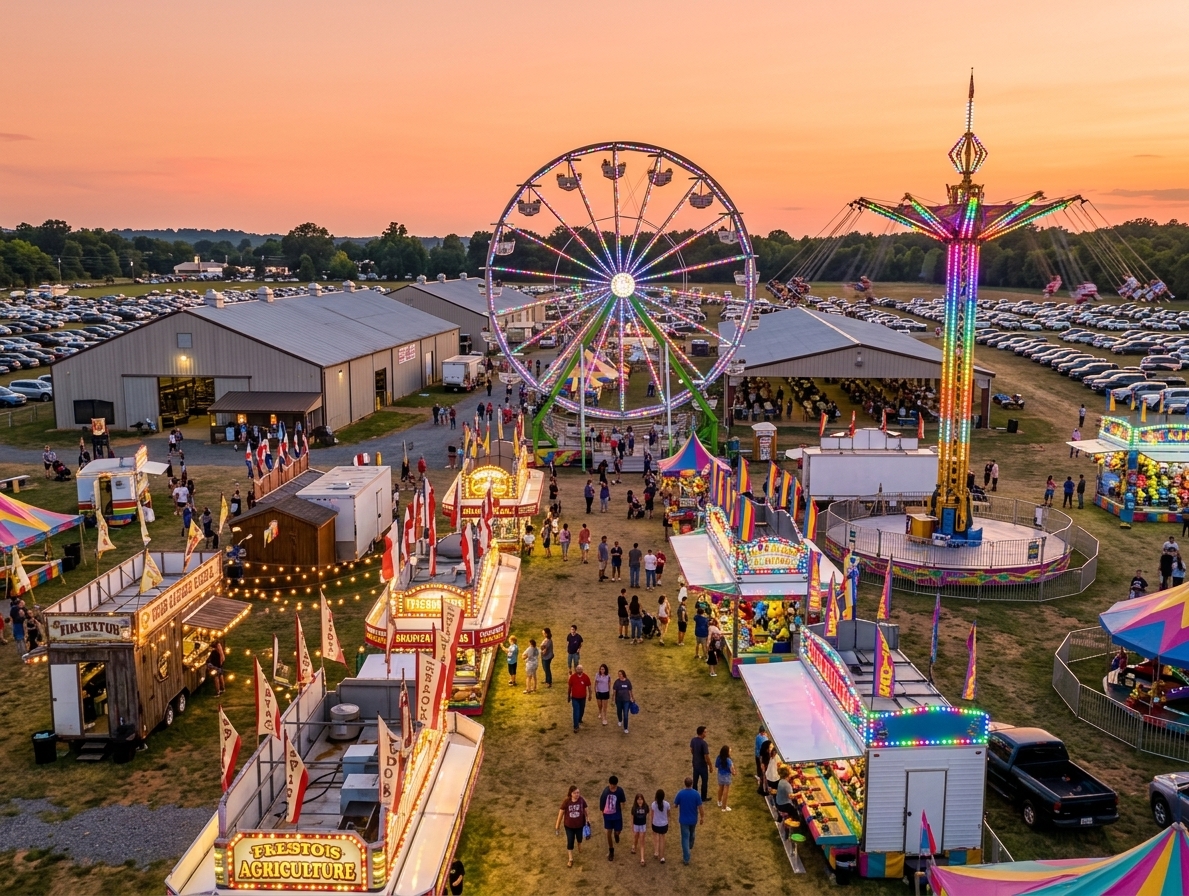
To complement traditional events, the fairgrounds now host a range of contemporary attractions. Carnival midways provide rides and games, while a motorsport area accommodates demolition derbies and mud‑bog events, drawing excitement from families and enthusiasts alike.
Community Connection
Today the fairgrounds function as a gathering place for the broader Fredericksburg community. From annual antique‑car showcases to seasonal festivals, the site bridges historic agricultural traditions with the vibrant, growing suburban life of the region.
Fredericksburg Agricultural Fair Exhibits
Visitors can explore a diverse array of exhibits that reflect both the fair’s longstanding heritage and its evolving entertainment offerings, making the grounds a must‑see destination for residents and guests.
Livestock & Blue‑Ribbon Exhibits Fredericksburg Fairgrounds
Rooted in more than two centuries of agrarian tradition, the fairgrounds welcome visitors to see livestock judged by seasoned farmers and to cheer the energetic 4‑H youth competitions that keep the spirit of agriculture alive.
Fair Attractions
Cattle judging and youth competitions, featuring the 78th annual Fredericksburg Area 4‑H & FFA Junior Livestock Show and Sale (May 2026).
Poultry exhibitslocated in the Commercial Building.
Giant produce, homemade jams, baked goods, and craftsdisplayed inside the Homemaking and Arts & Crafts building.
Additional livestock and agricultural displays—including rabbits, sheep, and other farm animals—that form a core component of the 10‑day summer fair (July 24 – August 2, 2026) at the Fredericksburg fairgrounds.
Midway Rides & Live Shows at Fredericksburg Fairgrounds
Midway Magic
Fair Attractions
Deggeller Attractionssupplies the midway rides, recognized by the OABA’s Circle of Excellence.
A classic carousel spins for all ages.
Family‑friendly games line the midway.
TheRockin‑A‑Ranch Petting Zoo, run byIvey Almond, offers pony and camel rides.
Music Stages & Daily Entertainment
Bullock Pavilion Stage hosts live performances.
Featured acts includePatsy’s Country Classics,Bullrun Cloggers,School of Rock, and Sunday Gospel ensembles such asVirginia Gospel Singers,Sonrise, andMike Milstead.
Special shows featureAckmonster’s Chainsaw Art by Brian Ackley, theAgricadabra Educational Agricultural Magic Show, comedy hypnotistBrad Matchett, and theGator Boys Road Show.
Motor Sports Park hosts demolition derby events, organized by Sonny Pippin.
The demolition derby features an opening night showdown and mid‑week competition.
The Mountain View Mud Bog provides off‑road excitement for spectators.
Year‑Round Community Events at Fredericksburg Fairgrounds
Fredericksburg’s fairgrounds serve as a year‑round hub for regional expos, community gatherings, and seasonal festivals, offering residents and visitors a versatile space to celebrate local culture and commerce. From bustling craft markets in the spring to holiday celebrations in the winter, the venue adapts to a wide range of events while preserving the spirit of the Fredericksburg Agricultural Fair. Its central location and spacious layout make it an ideal setting for everything from agricultural showcases to family‑friendly concerts, reinforcing its role as a cornerstone of community life.
Fairgrounds Community Events
Fall Family Festival
3rd Annual Pickle and Grilled Cheese Festival
Virginia Witches Pride Halloween Market
SGK Gun and Knife Show
Hot Tub & Spa Show
Showtime Sportscards Regional Card Show
Barony of Stierbach Holiday Faire
Cardboard Capital collectible show
Winter Wine Festival
Reptile Show (by Diamondback Productions)
Fredericksburg Fishing Flea Market
Greater Virginia Bridal Show
Fredericksburg Agricultural Fairgrounds Contact
Phone:(540) 373‑1294
Email:fredfair123@gmail.com
Mailing Address:PO Box 7585, Fredericksburg, VA 22404
Physical Address:2400 Airport Avenue, Fredericksburg, VA 22401
Stay in the Loop with Fredericksburg Fairgrounds
Check the fairgrounds’ calendar regularly to discover upcoming community events, festivals, and markets that bring locals together throughout the year.
Timeline of Milestones: America's Oldest Agricultural Fair
Year / Era | Milestone / Event | Historical Significance |
|---|---|---|
1738 | Colonial Charter: Bi‑annual fairs in Fredericksburg were directed for livestock, goods, and merchandise. | Establishes what is recognized as the oldest fair tradition in America. |
1751–1774 | Colonial Spectacles: Caroline Street horse races offered with a purse of 50 pistols by Charles Colson (1751), comedic plays by a Company of Comedians from the Theatre of Williamsburg (1752), and race meets by the Fredericksburg Jockey Club (1774). | Demonstrates the early integration of cultural entertainment, theatrical performances, and competitive sports into the colonial fair tradition. |
1887 | Post‑Reconstruction Revival: After a lapse in operations from 1881 to 1886, the fair was successfully relaunched. | Marked a major resurgence featuring hot air balloons, circuses, and thousands of agricultural exhibits by the turn of the century. |
1920s–1940s | Depression‑Era Hiatus: Economic struggles caused fair operations to pause for 16 years. | Reflects the severe economic toll of the Great Depression on local agricultural societies, eventually leading to bankruptcy of the original fair association. |
1948–1949 | Postwar Grassroots Renaissance: Local farmers and Jaycees, spearheaded by J.E. (Gene) Rowell, resurrected the fair under a massive 1,300‑foot tent featuring livestock and cowboy acts. | Revitalized the dormant tradition into the modern era of the Fredericksburg Agricultural Fair through community grassroots organizing. |
Late 1950s–Present | Permanent Fairgrounds & Expansion: Construction of permanent infrastructure including the fair office, cattle barns, exhibition halls, and utility structures at 2400 Airport Avenue, Fredericksburg, VA. | Established a permanent home to securely preserve farm heritage, host year‑round community events, and expand exhibition capacity into the 21st century. |
Frequently Asked Questions: History, Visiting & Traditions
Officially chartered in 1738, the Fredericksburg Agricultural Fair holds the distinction of being the oldest fair in America. The 1738 act directed that fairs be held in Fredericksburg twice a year for the sale of cattle, provisions, goods, wares, and merchandise. By comparison, other historic fairs such as York Fair in Pennsylvania (established in 1765) and Topsfield Fair in Massachusetts (established in 1818) were founded many years later.
The fair and its year‑round events are held at the Fredericksburg Fairgrounds, situated at 2400 Airport Avenue, Fredericksburg, VA 22401. The grounds include permanent cattle and livestock barns, exhibition halls, and a large parking area that accommodates thousands of vehicles.
Traditionally, the fair runs during late summer, spanning late July through early August. Gates typically open in the late afternoon on weekdays, from 5:00 PM to 10:00 PM, and open earlier on weekends, from 1:00 PM to 10:00 PM.
Community members may enter divisions such as culinary arts, photography, needlework, horticulture, and livestock competitions.
Entry forms, rule books, and contest guidelines are available on the official website, fredericksburgfair.org.
Residents can also join year‑round festivals, community gatherings, and venue rentals hosted at the fairgrounds.