It Wasn't Just One Bad Call: How a Night of Frustration Ended With an Injured Quarterback and Police at a High School Football Game
Questionable officiating, missed calls, mounting frustration, and one devastating final play turned a hard-fought contest between St. Michael and Woodberry Forest into a night that...

Fredericksburg · Community Photo
Questionable officiating, missed calls, mounting frustration, and one devastating final play turned a hard-fought contest between St. Michael and Woodberry Forest into a night that raised serious questions about youth sports, accountability, and the emotions of those who love the game.
GOFREDERICKSBURG | LOCAL SPORTS & COMMUNITY COMMENTARY
FREDERICKSBURG, VA —There are moments in sports when the final score doesn't begin to tell the story. Friday night's matchup between St. Michael the Archangel and Woodberry Forest was one of those moments.
Woodberry Forest walked away with a 21–20 victory. But what happened on the field, what happened along the sidelines, and what unfolded after a frightening injury to a teenage quarterback should concern everyone who cares about youth athletics.
I was there, and what I witnessed wasn't simply frustration over one controversial play. It was the culmination of an emotionally charged evening in which questionable officiating, missed calls, and mounting frustration appeared to push an already intense competition toward a breaking point. By the time law enforcement was called, the game itself had become secondary to something much bigger. A young man was injured, coaches were furious, parents were emotional, and players were caught in the middle. Somewhere in the chaos, we were reminded just how quickly a game played by young athletes can become overwhelmed by the actions and decisions of adults.
The Frustration Didn't Begin With the Final Play
This was not simply a case of a football team losing a close game and becoming upset with the referees. Throughout the evening, there were questionable calls and missed calls that fueled growing frustration. From my vantage point, the officiating was inconsistent, with decisions that were difficult to understand and others in which penalties appeared to go uncalled.
One questionable decision is frustrating. Two or three become difficult to ignore. But when those moments continue throughout a tightly contested game, frustration begins to build. Players become discouraged, coaches become increasingly animated, and parents in the stands begin questioning what they are watching. Every subsequent call carries the weight of the ones that came before it. And in a one-point football game, every yard, every possession, and every decision matters.
Officials have an extraordinarily difficult job, and no reasonable person should expect perfection. They are asked to make split-second judgments in a physical, emotional, fast-moving environment. But there must also be a reasonable expectation of consistency, fairness, and attention to player safety. When those expectations appear to be repeatedly unmet, confidence in the officiating begins to erode. That is what makes Friday night's events so important to understand.
The final controversial play did not create the frustration. It ignited frustration that had been building throughout the night.
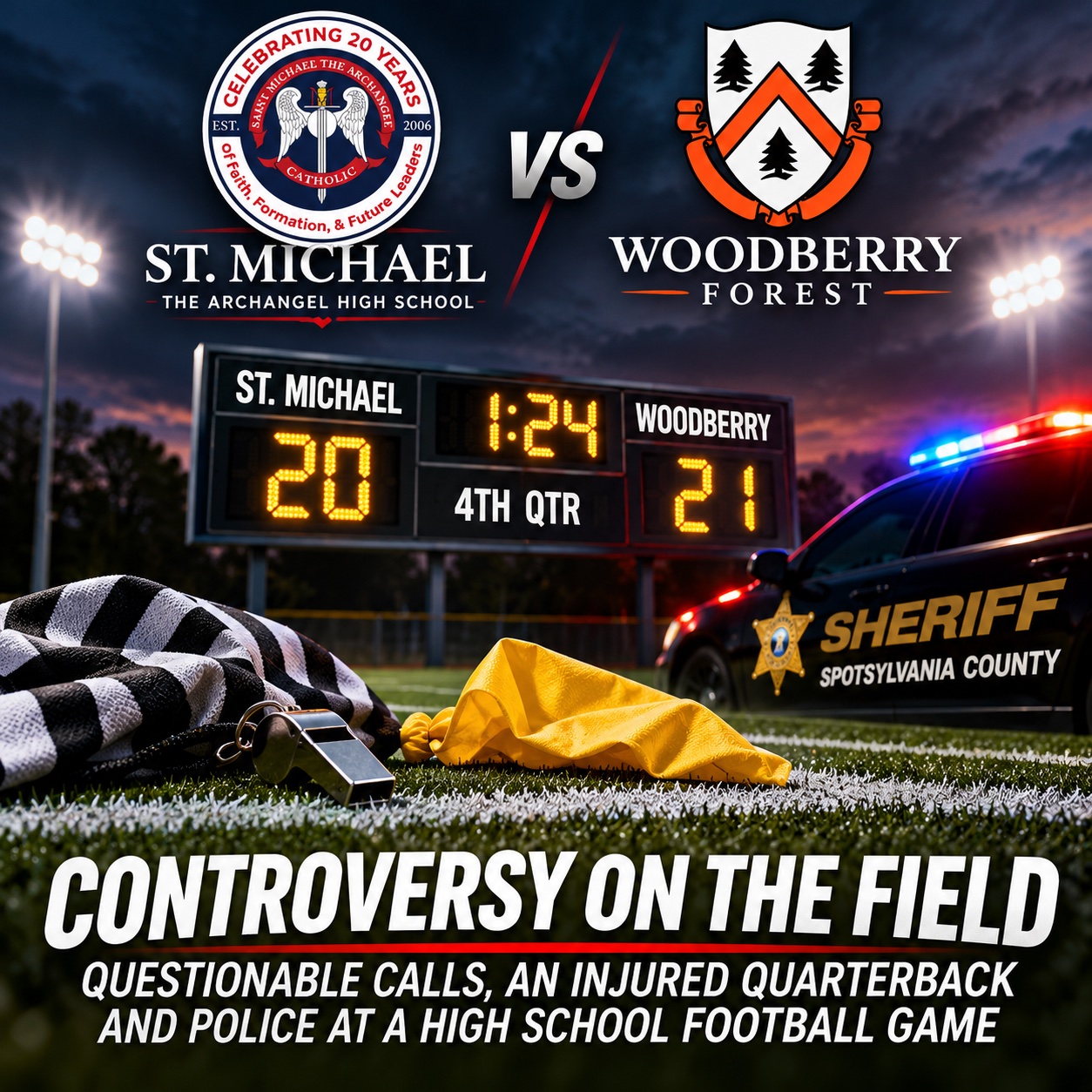
With approximately 1:24 remaining in the fourth quarter, St. Michael trailed Woodberry Forest 21–20. The Warriors were deep in opposing territory, facing fourth-and-goal. This was the kind of moment young athletes dream about, when an entire season's worth of conditioning, practices, sacrifices, and preparation comes down to one opportunity to win a football game against a tough opponent.
Junior quarterback Will Baze had stepped into a difficult situation following an injury to the starting quarterback Aiden Fulton. He took the snap, and on the ensuing play, he was tackled behind the line of scrimmage. But it wasn't simply the tackle that drew attention. It was an unmistakable facemask tackle, occurring directly in front of the white-hat referee — the head official — and yet no penalty flag was thrown.
For those who had watched questionable officiating decisions accumulate throughout the evening, this appeared to be another missed call. Only this time, the consequences were far more frightening. Baze remained down on the field, and the concern was no longer whether St. Michael would get another opportunity to score. It was whether this young man was okay.
When Football Suddenly Becomes Secondary
There is something profoundly unsettling about watching a teenage athlete lying injured on a football field. The cheering stops, the scoreboard becomes irrelevant, and the people who love that young man are left hoping and praying that he will get up.
St. Michael head coach Hugh Brown said his concern was not simply the disputed call or the outcome of the game. His immediate concern was Will Baze, who had suffered a frightening hit and was having difficulty breathing.
Put yourself in that position. You are a coach responsible for the safety and well-being of the young men entrusted to you. You have watched frustration grow throughout the evening, and then you see your quarterback take a hit, remain on the ground, and struggle to breathe. At that moment, you are not just a football coach. You are an adult responsible for a child, and while the emotions that followed deserve examination, we cannot lose sight of the fear that accompanies a moment like that.
The disputed final play became a flashpoint. Coaches protested, emotions rose, and the atmosphere intensified. Eventually, the Spotsylvania County Sheriff's Office was called to the scene.
Think about how extraordinary that is. A Friday night high school football game ended with police involvement. Not a professional sporting event with tens of thousands of spectators, but a game involving teenagers, their coaches, and families who had gathered to watch them compete. We should all find that troubling, but we also need to be careful about how we assign blame.
Was every reaction appropriate? That certainly deserves examination. Could the adults involved have handled their frustrations differently? Absolutely. But should we ignore the series of decisions and disputed calls that helped create such an emotionally charged environment? No.
Understanding why emotions boiled over is not the same as excusing inappropriate conduct. Criticizing how someone reacts to a situation should not prevent us from examining what contributed to that reaction in the first place. The game was eventually called with time still on the clock, leaving Woodberry Forest with the 21–20 victory and many unanswered questions about how the evening ended.
For Parents, It's More Than Just a Game
For parents, youth sports are personal. These aren't professional athletes earning millions of dollars. These are our sons and daughters, and we know what they've sacrificed to be on that field.
We watch them practice when they're exhausted. We see them come home disappointed after difficult losses. We help them through injuries, celebrate their accomplishments, and encourage them when they question whether all the work is worth it. We rearrange schedules, travel to games, make financial sacrifices, and invest countless hours because we understand how much these experiences mean to our children.
And sometimes, when we believe they are being treated unfairly, our emotions get the better of us.
Now imagine watching your child take a frightening hit and remain on the ground. Imagine believing that officials had missed yet another call after watching questionable decisions accumulate throughout the evening. Imagine the fear, frustration, and helplessness of seeing medical personnel attending to a young man while the emotions around the field continue to intensify.
Would you be emotional? Of course you would. That doesn't give anyone permission to threaten officials, engage in confrontations, or create an unsafe environment. But it does mean we should approach these situations with an understanding of the emotions involved.
Parents are human. Coaches are human. Officials are human. And perhaps most importantly, the athletes on that field are still young people learning how to navigate competition, disappointment, anger, and adversity. They are looking to the adults around them for guidance, and what they witness during moments like these can leave an impression long after the game is over.
Accountability Cannot Stop at the Sidelines
One of the most common responses whenever officiating becomes controversial is that coaches, players, and parents need to control themselves. That is true. Sportsmanship, self-control, and respect matter. But accountability cannot be a one-way street.
If coaches are expected to remain composed when calls go against them, officials must also be willing to have their performance evaluated when serious questions arise. If athletes are expected to learn from their mistakes, shouldn't the adults officiating those athletes be willing to do the same? And if schools expect parents to behave responsibly, shouldn't those same families have confidence that the games their children participate in are being officiated fairly and safely?
This isn't about demanding that officials never make mistakes. That's impossible. It is about recognizing that repeated questionable calls and missed penalties can affect more than the outcome of a football game. They can influence how players respond to physical contact, how coaches manage their teams, and how an entire stadium reacts as frustration grows.
There also needs to be an important distinction between a bad call and intentional wrongdoing. There is no basis to assume officials deliberately tried to influence the outcome. But a lack of malicious intent does not mean poor decisions, if confirmed, should go unaddressed.
Friday night's officiating deserves review, not simply because St. Michael lost, but because the events that unfolded were far too serious to dismiss as ordinary postgame frustration.
Several legitimate questions remain. Were the officials consistent in their application of the rules throughout the game? Were penalties missed, particularly those involving player safety? What did the officials see on the final play involving Baze, and why was no penalty assessed? Could growing tensions have been managed more effectively before reaching a breaking point? What circumstances led to law enforcement being called, and why was the decision made to end the game before the remaining time had expired?
These are not unreasonable questions. They are questions that deserve answers when a youth sporting event ends under circumstances like these. A fair review should consider available video, the applicable rules, and accounts from everyone involved, including the officials. If mistakes were made by referees, coaches, or anyone else, the goal should be to acknowledge them, learn from them, and prevent another night like this.
What Are We Teaching Our Children?
This is where the story becomes bigger than St. Michael, Woodberry Forest, or even football.
We tell our children that sports build character. We teach them to respect authority, compete hard, play fair, accept defeat with dignity, and never allow frustration to control their behavior. Those are important lessons, but what happens when the adults responsible for overseeing competition become part of the controversy?
What do we teach our children when legitimate concerns about fairness and safety appear to go unanswered? What do we teach them when frustration turns into confrontation? And what do we teach them when a game ends with police arriving instead of the final whistle bringing everyone together?
The lesson cannot simply be that life isn't fair. Of course life isn't always fair, but that does not absolve adults of the responsibility to strive for fairness. It doesn't mean we shouldn't demand accountability, and it certainly doesn't mean player safety should ever become secondary to defending an officiating decision.
There is a balance here. Athletes must learn to control their emotions, coaches must lead by example, parents must remember that their actions influence their children, and officials must understand the enormous responsibility they carry every time they step onto a field filled with young athletes.
Respect is a responsibility shared by everyone involved in youth sports, and accountability should be no different.
The Score Will Be Forgotten. The Night May Not Be.
Years from now, most people will not remember that Woodberry Forest defeated St. Michael 21–20 on a November Friday night. They probably won't remember which team had the football with 84 seconds remaining or exactly where the ball was spotted. But the athletes who stood on that field may remember the frustration, the fear of watching their teammate injured on the ground, their coaches' reactions, and the arrival of law enforcement.
They may also remember how the adults responsible for the game handled everything that happened afterward.
That is why this story matters. Not simply because one team believes it was denied an opportunity to win or because fans were unhappy with the officiating, but because a night intended to celebrate young athletes became a reminder of what can happen when competitive pressure, questionable decisions, fear, and frustration collide.
We should not minimize the emotions of those who were there, excuse inappropriate behavior, or dismiss legitimate questions about officiating simply because the game is over. All of those concerns deserve to be taken seriously, and all of them can be addressed without losing sight of the people who matter most.
At the center of it all was a teenage quarterback who needed medical attention, surrounded by teammates who cared about him and adults who were supposed to protect the integrity and safety of the game.
Because the moment we become more concerned with defending a call, winning an argument, or assigning blame than protecting the young people on the field, we have forgotten why youth sports exist in the first place.
Friday night's game may be over, but the conversation it started shouldn't be. The officiating deserves scrutiny. The decisions made by adults deserve examination. The emotions of the athletes and families deserve to be understood. And the safety of the young people who participate in these games must remain the highest priority.
Perhaps the most important lesson is one that every referee, coach, parent, and player can carry onto the next field:
These are kids. This is their game. And every adult involved has a responsibility to do better.
GoFredericksburg firsthand reporting and community commentary. This article is based on the author's observations at the November 6, 2026, game. Observations concerning officiating are presented as eyewitness assessments; specific rule violations and the rationale for ending the game have not been independently adjudicated.
Share this story
Facebook·X·LinkedIn·Reddit·WhatsApp·Email
Stay connected to what's happening in Fredericksburg
Stories like this one are why we love this community. Join the GoFXBG Facebook page for local news, events, and the good stuff happening around town, and tell us in the comments what you'd like to see next.