Virginia Voters Approve Redistricting Amendment — A Move That Could Reshape Congress

Fredericksburg · Community Photo
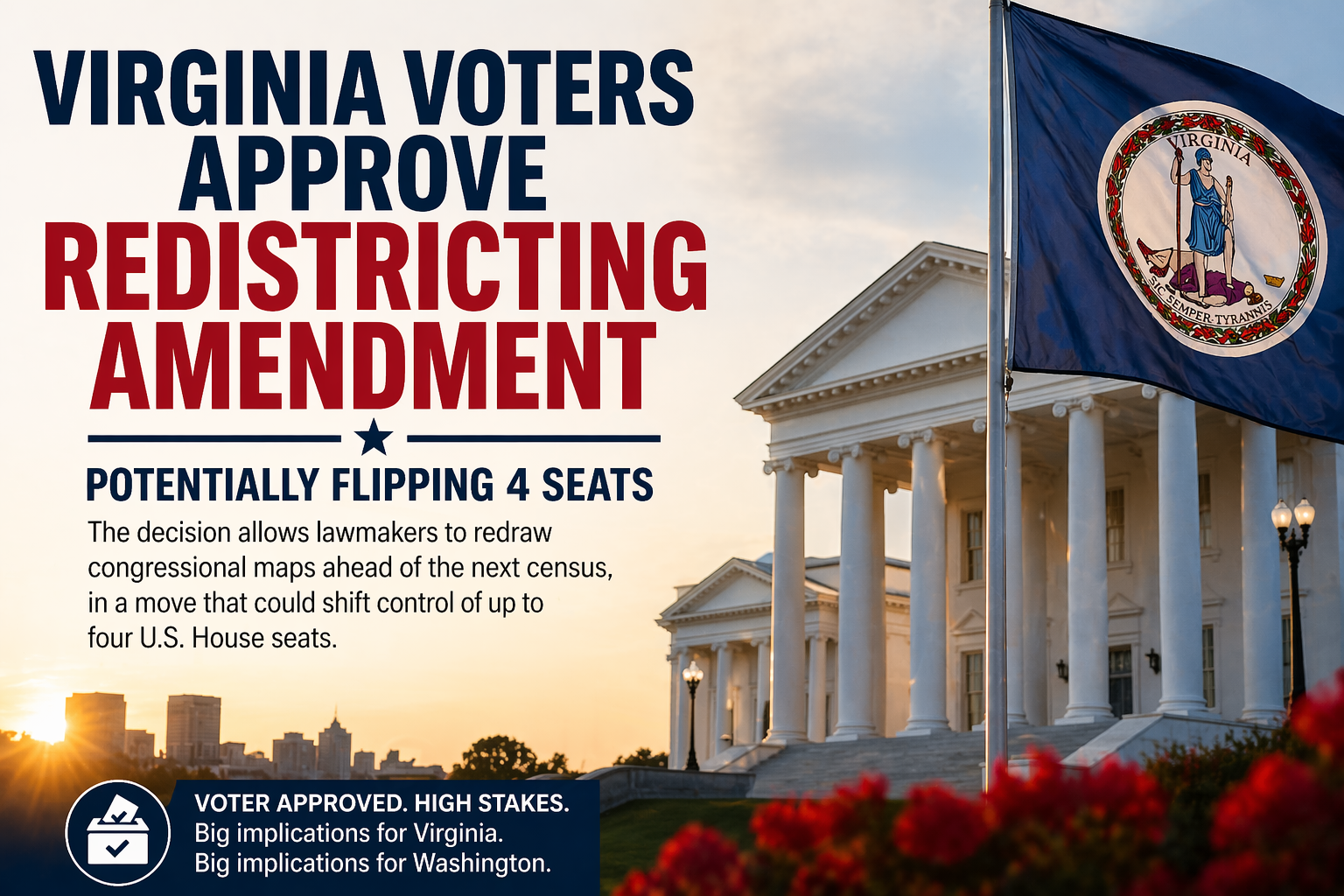
In a decision that could ripple far beyond state lines, Virginia voters have approved a redistricting amendment that may significantly alter the balance of power in Washington. While redistricting rarely grabs mainstream attention, this vote has quickly become one of the most consequential political developments of the year.
At its core, the amendment allows Virginia lawmakers to redraw congressional district maps ahead of the next census cycle. Traditionally, redistricting occurs every ten years following new census data. This move, however, accelerates that process—opening the door for immediate political impact.
And the impact could be substantial.
A Potential Shift of Four Seats
Early projections suggest that the newly approved maps could flip as many as four Republican-held seats to Democratic control. In a U.S. House that is often decided by razor-thin margins, a shift of even a few seats can determine which party holds power.
Virginia, once considered a battleground state, has trended more Democratic in recent years. This redistricting effort appears to reinforce that shift, potentially reshaping the state’s congressional delegation for the foreseeable future.
If projections hold, Virginia’s representation in Congress could move toward a much stronger Democratic majority—something that would have national implications heading into the next election cycle.
Why This Is So Controversial
As expected, reactions have been sharply divided.
Supporters of the amendment argue that it is a necessary response to similar redistricting efforts in other states. Across the country, both parties have used map-drawing as a political tool, and proponents say this simply ensures Virginia is not left at a disadvantage.
Critics, however, see it very differently.
Opponents argue that the amendment undermines the spirit of fair representation, calling it a clear example of partisan gerrymandering. They believe voters should choose their representatives—not the other way around—and warn that this could erode trust in the electoral system.
This tension highlights a broader national issue: redistricting has increasingly become a political chess match, with both sides seeking any advantage they can gain.
What Happens Next
Despite voter approval, this story is far from over.
Legal challenges are already expected, and the courts could play a major role in determining whether the new maps ultimately stand. Redistricting battles frequently end up in front of judges, and Virginia is unlikely to be any different.
If the maps are upheld, they will likely be used in the 2026 midterm elections—setting the stage for one of the most closely watched election cycles in recent history.
Why It Matters Locally
For residents here in Virginia—including communities like Fredericksburg, Spotsylvania, and Stafford—this isn’t just a political headline. Changes in district lines can directly impact representation, local priorities, and how effectively communities are heard at the federal level.
Who represents you in Congress affects everything from infrastructure funding and economic development to education and housing policy. In that sense, redistricting is not just about politics—it’s about influence.
The Bigger Picture
What’s happening in Virginia is part of a much larger national trend. Redistricting battles are unfolding across the country, with both parties aggressively shaping maps in key states.
The reality is simple: control of Congress can hinge on decisions like this.
Virginia just made one.